

Garage Doors in the Rapid Door Industry: Technological Evolution, Market Trends, and Applications
1. Core Features and Technical Advancements
Drive and Control Systems
Modern garage doors leverage Programmable Logic Controllers (PLCs) and variable frequency drives (VFDs) to achieve smooth acceleration/deceleration, with operating speeds of 0.6–2.1 m/s, balancing efficiency and safety. High-end models integrate rotary encoders for positioning accuracy within 0.3 mm, enabling customizable height adjustments.Smart Controls: Support remote operation, radar/magnetic induction triggers, and infrared anti-collision systems. Emergency braking mechanisms prevent accidents.
Material and Structural Innovations
Curtain Materials: PVC and PVDF films dominate, with PVDF offering UV resistance and self-cleaning properties for hygienic environments. Reinforced PVC fabrics meet flame-retardant (e.g., NF-P92-503 M2 standards) and corrosion-resistant requirements.
Frame Design: Frames use 2.0 mm cold-rolled steel or 3.5 mm oxidation-resistant aluminum alloy, withstanding wind loads up to Level 12 (Beaufort scale). Reinforced bottom rails enhance stability in extreme weather.
Energy Efficiency and Sustainability
Advanced sealing systems reduce air leakage, improving thermal insulation. Recyclable aluminum alloys and lead-free coatings align with green building policies.
2. Applications and Market Demand
Residential Sector
Key Needs: Security (anti-theft alarms), durability, and smart features (remote control). Smart garage doors now account for 35% of the residential market (2023), driven by urbanization in eastern coastal regions (e.g., Shanghai, Beijing).
Commercial and Industrial Sectors
Commercial Complexes: Aesthetic designs (e.g., transparent PVC curtains) enhance branding for offices and shopping centers.
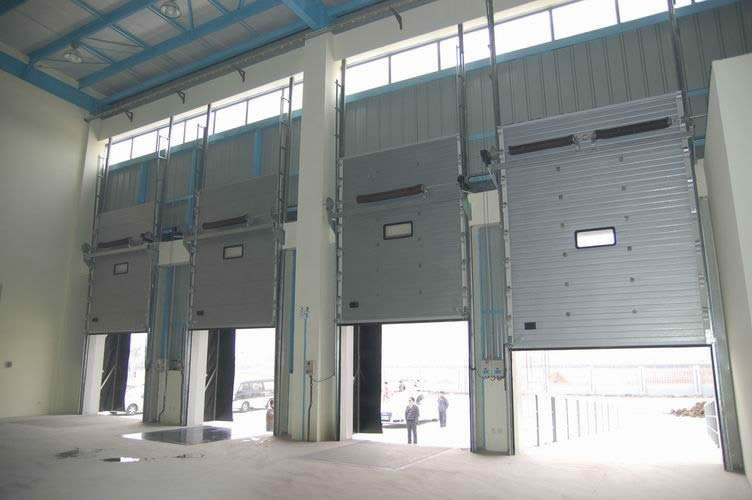
Industrial Use: Warehouses and logistics parks demand large-scale doors (widths up to 6.1 m) with high-frequency operation (500–800 cycles/day) and impact resistance.
Specialized Environments
Explosion-Proof Requirements: Chemical/pharmaceutical industries adopt anti-static designs, explosion-proof control panels, and airtight seals compliant with ISO Class 8 cleanroom standards.
Harsh Climates: Low-temperature motors (-40°C tolerance) and frost-resistant tracks ensure reliability in cold regions.
3. Market Trends and Competitive Landscape
Market Size and Growth
China’s garage door market reached 168 billion (¥1.2 trillion CNY) by 2025, with an 8% CAGR. Smart doors drive growth, rising from 15% market share in 2019 to 35% in 2023.
Regional Dynamics: Eastern regions hold 60% market share, while central/western areas grow at 12% due to urbanization.
Technology-Driven Trends
IoT Integration: AI object recognition and multi-door synchronization enable automated logistics coordination (e.g., AGV systems).
Customization: Demand for non-standard sizes (e.g., widths >10 m) spurs flexible production upgrades.
Regulatory and Policy Drivers
Government Initiatives: Smart City Development Guidelines promote smart garage door adoption, with tax incentives for energy-efficient models.
Compliance Standards: Mandatory adherence to Garage Door Safety Codes and Building Energy Efficiency Standards phases out inefficient products.
Competitive Landscape
Market Leaders: Control 30% share via proprietary technologies (e.g., localized encoders) and supply chain integration.
SMEs: Focus on regional markets with rapid installation and tailored services, targeting logistics firms in central/western China.
4. Challenges and Future Outlook
Technical Barriers
Reliance on imported precision components (e.g., encoders) keeps localization rates below 40%, inflating costs.
High-frequency use accelerates wear; modular designs and predictive maintenance systems are critical.
Strategic Opportunities
Market Expansion: Simplify features (e.g., basic remote-control models) to penetrate tier-3/4 cities and rural areas.
Global Exports: Southeast Asia and Africa drive 15% export growth (2024 forecast) for cost-effective Chinese products.
Sustainability Innovations
Eco-Materials: Develop bio-based PVC and biodegradable seals to reduce carbon footprints.
Energy Solutions: Solar-powered drives and energy recovery systems align with net-zero building standards.
1. Q: How have garage doors evolved in the rapid door industry?
A: Modern garage doors now feature faster operation, improved durability, and smart technology integration. Advances include quieter motors, stronger materials, and automated controls, making them more efficient and user-friendly than traditional models.
2. Q: What are the latest trends in garage door technology?
A: Current trends include Wi-Fi-enabled smart garage doors (controlled via smartphone), energy-efficient insulation, enhanced security features (like fingerprint or facial recognition), and quieter, high-speed opening mechanisms.
3. Q: Where are high-performance garage doors commonly used beyond residential homes?
A: Besides homes, they are widely used in commercial warehouses, car dealerships, fire stations, and industrial facilities—anywhere quick access, security, and durability are essential.
4. Q: How do modern garage doors improve security?
A: They incorporate rolling-code remote controls, tamper-resistant locks, and real-time alerts (via smartphone notifications) to prevent unauthorized access. Some models even have built-in cameras for added surveillance.
5. Q: What factors should be considered when choosing a garage door for industrial use?
A: Key factors include speed of operation, material strength (steel or aluminum for heavy-duty use), insulation (for temperature control), safety sensors, and compatibility with automation systems.
Recommended Products

up to dateQatar Automatic Door Accessories
- Durable PVC Fast Rolling Door Fittings for Enhanced Security
- Automatic Repair of Zipper Door Plastic/Polymer Rails
- Smart Automatic Door Sensor for Fast Rolling Access Control
- Soft Fast Gate Control System 1.5kw Servo Motor and Control Box
- Automatic Access Control Square Surface Mount Infrared Non-Contact Switch
- Explosion-Proof Reinforced Self-Limiting Electric Heating Belt
- Explosion-Proof Shielded Self-Controlling Temperature Electric Heating Belt
- Heating Belt for Anti-Freezing, Heating and Heat Preservation of Cold Storage Doors
- 40W flame retardant explosion-proof self-limiting electric heating belt
- High Speed Door Zippers Industrial Door Zippers
- Safety Beam Sensor Use for Automatic Door
- Wireless Hand Sensor Switch For Automatic Door
- Hospital Door Foot Sensor
- Automatic Sliding Door System Wireless Touch Press Switch
- Automatic Sliding Door IP65 Waterprooft Wireless Hand Press Switch
- Automatic Door Microwave Sensor
- Reflective Type Infrared Detector
- Automatic High Speed Door Infrared Radar Sensor CNB-204G
- Aluminum Alloy Wind Section For PVC rapid roller shutter door
- Aluminum Bottom Section For PVC high speed rolling shutter door