

Slat d'obturateur en acier galvanisé/acier inoxydable 1: un guide complet des types et des applications
I. Logique de classification et paramètres clés des lames d'obturation
Les lamelles d'obturateur sont classées selon trois dimensions clés, avec des différences distinctes en matière de sécurité, de durabilité et d'esthétique selon les types.
1. Matériaux: Acier galvanisé contre acier inoxydable
Lames en acier galvanisé : tôles d'acier laminées à froid avec revêtement de zinc, offrant un faible coût et une bonne résistance à la rouille. Idéal pour les environnements industriels et commerciaux généraux (p. ex., entrepôts, magasins de détail).
Lames en acier inoxydable : Fabriqué en acier inoxydable 304/201, offrant une résistance à la corrosion supérieure et une surface élégante. Convient aux espaces commerciaux haut de gamme, aux usines de transformation alimentaire et aux environnements humides côtiers.
2. Spécifications structurelles: Nommé par "Largeur + Fonction"
Les spécifications de la lame sont principalement identifiées par la largeur (mm), comme 76 #, 82 #, et 120 #, où le nombre représente la largeur étendue de la lame. Ils sont en outre classés par la conception structurelle (par exemple, plat, courbé, perforé) et la fonctionnalité (par exemple, résistant au feu, résistant au vent, anti-vol), par exemple, "82# lame renforcée courbe résistante au vent".
3. Paramètres techniques clés
épaisseur : plage commune 0,3-1,2 mm. Les lames plus épaisses améliorent la capacité de charge et la résistance aux chocs (par exemple, les lames de 120 #, d'épaisseur de 0,8 à 1,2 mm, sont utilisées pour les grandes usines).
Résistance à la traction : Acier galvanisé: ~235-345MPa; Acier inoxydable: ~520MPa. Une résistance plus élevée réduit les risques de déformation.
Résistance au vent : Les lames courbes (par exemple, type renforcé courbe de 120 #) résistent jusqu'à 12 grades de force du vent, surpassant les lames plates (8-10 grades).
II. Analyse approfondie des types et applications de lames courants
1. Série 76# : léger et économique pour les petites et moyennes ouvertures
Les lames 76# (largeur 76mm, épaisseur 0,3-0,5mm) sont légères et faciles à installer, adaptées aux ouvertures ≤4 mètres de large.
Types typiques et paramètres:
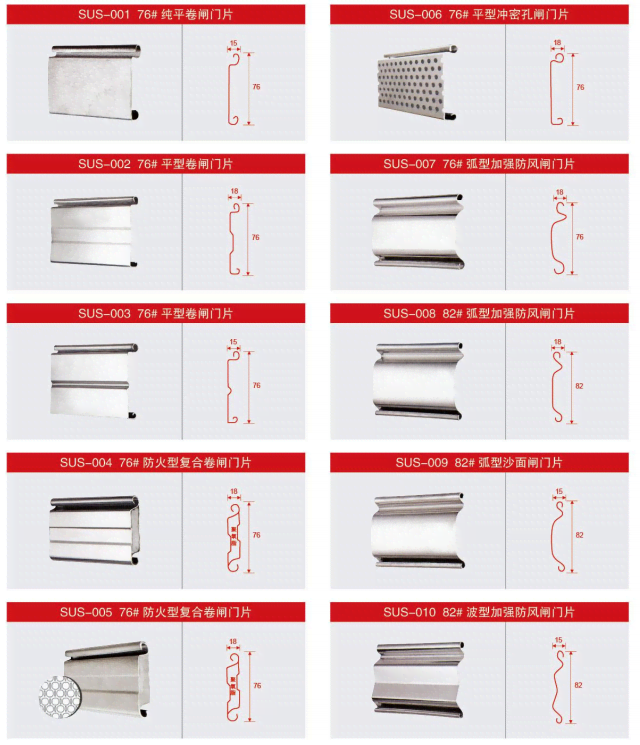
SUS-001 lame plate : Conception lisse, non perforée pour les magasins généraux et les garages. Durée de vie: 5-8 ans.
SUS-006 lame plate perforée : Également répartis trous φ5mm équilibre ventilation (débit d'air de 15 à 20 %) et sécurité. Idéal pour les marchés et les entrepôts ventilés.
SUS-004 feu résistant à la lame composite : Structure à double couche avec coton résistant au feu, ≥1,5 heure de résistance au feu (conforme à GB 14102-2005). Utilisé dans les sorties d'incendie et les salles électriques.
2. Série 82# : Performances et coûts équilibrés pour les espaces commerciaux
Les lames 82# (largeur 82 mm, épaisseur 0,4-0,7 mm) offrent une meilleure résistance à la charge et au vent que les lames 76#, couvrant plus de 80% des vitrines commerciales.
Types typiques et paramètres:
SUS-008 Lame résistante au vent renforcée courbe : Profil courbé avec nervures de renforcement, ≥10 résistance à la force du vent. Réduit la déformation de 40 % par rapport aux lames plates, adapté aux immeubles commerciaux de grande hauteur et aux magasins côtiers.
SUS-016 lame à motifs courbes : Les surfaces en relief (par exemple, diamants, motifs de chrysanthèmes) améliorent l'esthétique et la résistance. Utilisé dans les boutiques de marque et les supermarchés.
SUS-009 lame sablée courbe : finition mate, résistante aux empreintes digitales pour un nettoyage facile. Répond aux normes GMP pour les usines de transformation alimentaire et les salles propres.
3. Série 120# : qualité industrielle lourde pour les ouvertures à grande échelle
120# lames (120mm de largeur, 0,8-1,2mm d'épaisseur) pèsent 15-20kg/ ㎡, conçu pour les ouvertures ≥6 mètres de large (p. ex., usines, entrepôts logistiques).
Types typiques et paramètres:
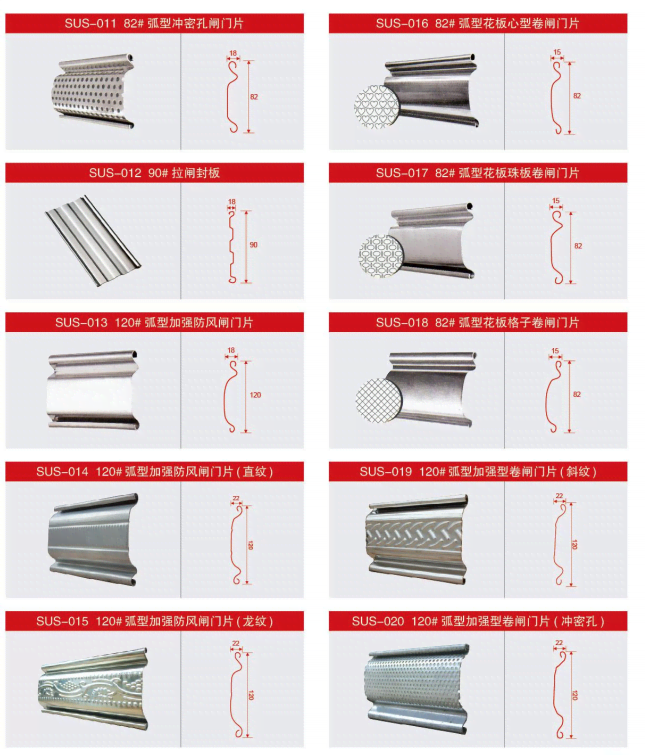
SUS-013 120 # lame résistante au vent renforcée courbée : section transversale en forme d'onde avec structure pliable à double couche, résiste à 12 grades de force du vent (pression du vent ≥0.7kPa). Utilisé dans les entrepôts portuaires et les grands ateliers.
SUS-019 Diagonal modèle renforcé lame : Diagonale 纹路 augmente la résistance à la traction de 25%, avec une résistance aux chocs de 15J (norme GB / T 228). Convient aux canaux logistiques avec un trafic fréquent de chariots élévateurs.
SUS-020 lame perforéeLes trous rectangulaires (10 x 30 mm) fournissent un débit d'air de 30%. Associé à des grilles anti-vol pour les salles de machines ventilées.
III. Guide de sélection en quatre étapes
Positionnement du scénarioChoisissez les lames décoratives 82# pour les façades commerciales, les lames lourdes 120# pour les installations industrielles et l'acier inoxydable pour les environnements humides.
Priorisation des performances:
Anti-vol: Sélectionnez des lames épaisses (≥0.8mm) + serrures anti-piquant.
Sécurité incendie : choisissez des lames composites certifiées.
Ventilation : optez pour des lames avec un taux de perforation de 15 à 30 %.
Évaluation des coûtsLes lamelles en acier galvanisé ont des coûts initiaux plus bas mais une durée de vie de 5 à 10 ans plus courte que l'acier inoxydable, ce qui rend l'acier inoxydable plus rentable à long terme.
Compatibilité d'installationL'épaisseur de la lame doit correspondre à la capacité de roulement des rouleaux (par exemple, les lames de 120 # nécessitent des rouleaux de diamètre ≥80mm).
IV. Questions fréquemment posées (FAQ)
Q1: Comment choisir entre les lamelles en acier galvanisé et en acier inoxydable?
R: L'acier galvanisé est idéal pour les environnements secs à faible budget (par exemple, ateliers). L'acier inoxydable convient aux zones humides (régions côtières, usines alimentaires) et aux espaces commerciaux haut de gamme (magasins de luxe). Dans le nord de la Chine, l'acier galvanisé offre une meilleure valeur; dans les régions pluvieuses du sud, l'acier inoxydable réduit l'entretien lié à la rouille.
Q2: L'épaisseur est toujours meilleure pour l'épaisseur de la lame?
R: Non. Par exemple, une vitrine de 3 mètres de large fonctionne bien avec des lames 82 # d'épaisseur de 0,5 mm. Les lames trop épaisses (par exemple, 1,2 mm) peuvent surcharger les rouleaux et provoquer des pannes de moteur. Considérez la largeur d'ouverture et la fréquence d'utilisation.
Q3: Comment le traitement de surface affecte-t-il les performances?
A: Les lames en acier galvanisé peuvent utiliser un revêtement en poudre (couleurs personnalisées) ou une peinture à cuire (résistance aux intempéries améliorée). Les lamelles en acier inoxydable peuvent être brossées ou mirrorisées. Les lames revêtues de poudre offrent une meilleure résistance à la corrosion de 2 à 3 ans que les lames galvanisées standard, adaptées à l'utilisation extérieure.
Q4: Comment évaluer la qualité de la lame?
A: ① Mesurer l'épaisseur avec des étriers pour éviter la déformation. ② Vérifiez la lisseur des soudures (pas de rebures ou d'interférences). ③ Fonctionnement d'essai: Les lames doivent s'ouvrir/se fermer en douceur sans brouillage, indiquant une conception structurale saine.
Ce guide clarifie les types de lames, les paramètres et les applications pour aider les lecteurs à équilibrer la sécurité, l'économie et la compatibilité. Pour obtenir des résultats optimaux, consultez les fabricants pour les calculs de charge afin de s'assurer que les lames répondent à des besoins spécifiques.
Produits recommandés
Accessoires de porte automatique
- Capteur de bord de sécurité pour la protection anti-écrasement de la porte roulante rapide
- Boîte de commande servo-moteur 0,75KW à porte haute vitesse - Solution d'entraînement fiable et efficace
- Servo-moteur de 1,5 kW et boîte de commande - système d'entraînement à haute efficacité pour portes industrielles
- Fermetures à glissières de porte industrielles et fermetures à glissières de porte à grande vitesse - Accessoires de porte industriels durables
- Servo-entraînement à porte haute vitesse de 0,75KW - Solution industrielle fiable et économe en énergie
- Activateur de pédale de pied et capteur de barrière de faisceau de sécurité pour les portes coulissantes médicales
- Fermetures à glissières de porte industrielles et fermetures à glissières de porte à grande vitesse - Accessoires de porte industriels durables
- AOK-AC123 Rideau électrique Télécommande - Design sans fil avec vitrage en cristal acrylique résistant à l'usure
- Servo-moteur synchrone AC à aimant permanent avec mécanisme de réduction de ver pour porte à grande vitesse
- Servo-moteur synchrone de précision pour réduction de vitesse de porte haute vitesse
- Nouveau commutateur de capteur infrarouge imperméable à la surface
- Remplaçages de porte en PVC durables pour une sécurité renforcée
- Réparation automatique des rails en plastique / polymère de porte à fermeture à glissière
- Capteur de porte automatique intelligent pour le contrôle d'accès à roulement rapide
- Système de commande de porte rapide souple 1.5kw Servo moteur et boîte de commande
- Contrôle d'accès automatique Square Surface Mount Infrared Non-Contact Switch
- Ceinture de chauffage électrique auto-limitante renforcée à l'épreuve des explosions
- Ceinture de chauffage électrique à température auto-controllée à l'épreuve des explosions
- Ceinture de chauffage pour antigel, chauffage et préservation de la chaleur des portes de stockage froid
- Ceinture de chauffage électrique auto-limité ignifuge 40W anti-explosion